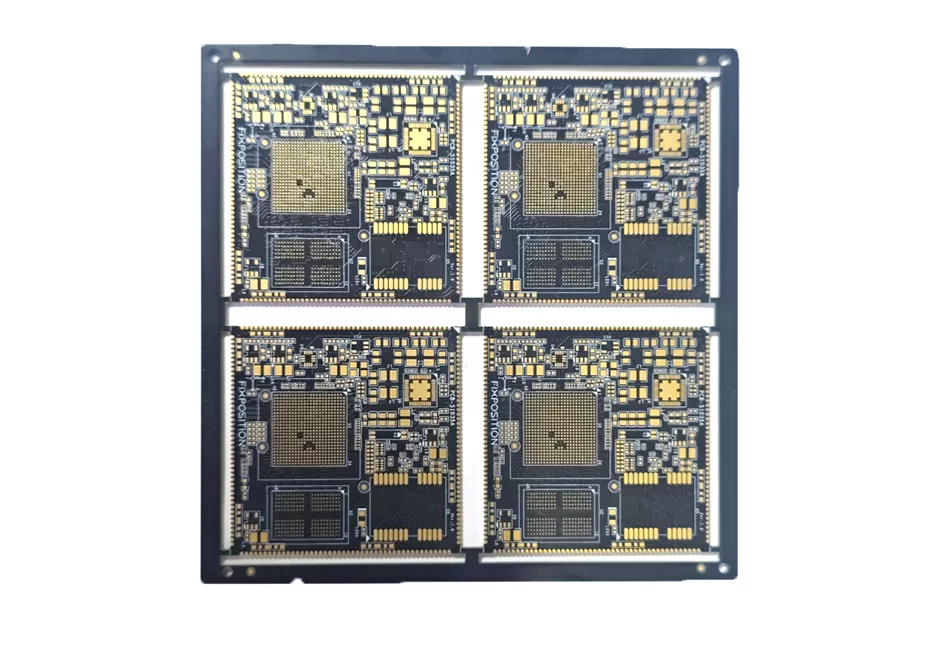



A PCB is priced on a panel, not on a board. The quote you receive is the panel price divided by the number of good boards on that panel, so the array — not just the board area — decides the unit cost.
Two designs with the same area can differ by 30% in price because one arrays 20-up and the other 15-up. This article explains how panelization works, how to calculate utilization, and which changes actually move the price.
Panel basics
A fabrication panel is a standard size chosen for the press and the process equipment, commonly 18 × 24 in (457 × 610 mm) or 21 × 24 in. Your board is arrayed on it with:
- Rails at the panel edge, typically 5–10 mm, for handling and tooling.
- Spacing between boards, typically 1.6–3 mm, for routing or V-score.
- Fiducials for assembly alignment.
- Tooling holes for registration.
The array is not free space. Every millimetre of rail or spacing is panel area that cannot carry a board.
Utilization math
Utilization is the board area divided by the panel area, multiplied by the number of boards:
``` Utilization = (board area × boards per panel) ÷ panel area ```
Take a 100 × 100 mm board on an 18 × 24 in panel with 5 mm spacing. The array is 4 columns × 5 rows = 20 boards, or about 72% utilization.
Grow the board to 110 × 110 mm and the array drops to 3 × 5 = 15 boards, about 65%. The board is 21% larger, but the panel yields 25% fewer boards, so material cost per board rises by a third.
This is why a 10 mm shrink can be worth more than a 10% quantity increase. It is also why the question "can you reduce the rail?" is a legitimate cost question.
What changes the array
- Board dimensions. Crossing a panel threshold costs a whole row or column.
- Spacing and rail width. Smaller spacing fits more boards but reduces routing and breakaway margin.
- Array orientation. Rotating the board can change the count, especially on rectangular parts.
- Breakaway method. V-score needs a straight line and a minimum web; routed tabs need more spacing.
- Tooling and fiducials. They consume area but are required for assembly.
Breakaway: V-score versus routed tabs
V-score cuts a V-shaped groove along a straight line and breaks the board out after assembly. It is fast and cheap, but it needs a straight edge and leaves a small web.
Routed tabs (mouse bites) use small holes and a routed slot. They allow curved outlines and mixed shapes, but need more spacing and can leave burrs.
The choice affects the array: V-score usually allows tighter spacing, routed tabs need more room for the bit and the tab.
Cost levers, in order of impact
- Board size: crossing a threshold changes the count by a row or column.
- Panel size: a larger panel may fit more boards but not every fabricator runs it.
- Spacing and rail: tightening them can add a row, but check breakaway and assembly.
- Array orientation: free to try, sometimes adds one board per row.
- Breakaway method: V-score is usually cheaper than routed tabs.
- Assembly panel: a separate assembly array may be needed for small boards.
When panelization hurts
More boards per panel is not always better:
- A dense array can warp during reflow, especially with thin boards.
- Too little spacing makes routing and inspection difficult.
- A panel that is too large for the assembly line slows handling.
- Mixed boards on one panel complicate testing and traceability.
The best panel is the one the fabricator can build and the assembler can run, not the one with the highest theoretical count.
DFM rules
| Parameter | Typical value | Effect |
|---|---|---|
| Rail width | 5–10 mm | Handling and tooling |
| Board spacing | 1.6–3 mm | Routing, V-score, breakaway |
| Fiducial clearance | 1–2 mm | Assembly alignment |
| Copper to edge | Per fabricator rule | Prevents burrs and shorts |
| Panel size | 18 × 24 or 21 × 24 in | Press and equipment limit |
| Array orientation | Try both | May add a board per row |
FAQ
Does a smaller board always cost less per unit?
Usually, because more boards fit on a panel. But if the board is already small, handling and assembly may dominate the cost.
Can I choose the panel size?
You can request it, but the fabricator's press and process equipment set the limit. The quote should state the panel size used.
Is V-score always cheaper than routing?
Usually, for straight outlines. Curved or mixed shapes need routing, and the spacing requirement changes the count.
Why does my quote change when I only changed the rail?
Because the rail can change the number of rows or columns on the panel. A 2 mm change can add or remove a whole row.
What to send for a panelization review
- Board dimensions and outline
- Array preference and orientation
- Breakaway method
- Assembly requirements and fiducials
- Panel size preference
- Quantity and delivery schedule
Send your board for a panelization review, or read how PCB quotes are calculated and review our PCB fabrication service.
Reviewed by the Benchuang process engineering team.