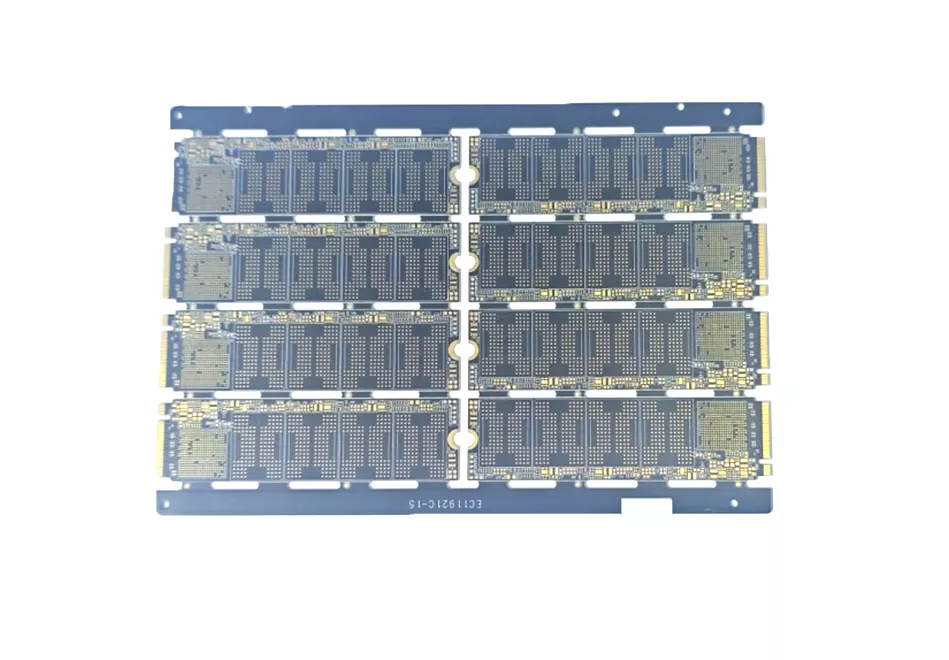



Two engineers can describe the same HDI board as "2-order" and "2+N+2" and still disagree about what will be built. One counts build-up layers per side, the other counts total build-up layers, and the fabricator quotes a third interpretation.
Order count is not a label. It decides how many lamination cycles the board needs, how many laser drilling passes, how tight the registration has to be, and therefore the price and the yield.
This article explains what the notation counts, how to read the common builds, and what to put on the stackup drawing so the quote matches the board.
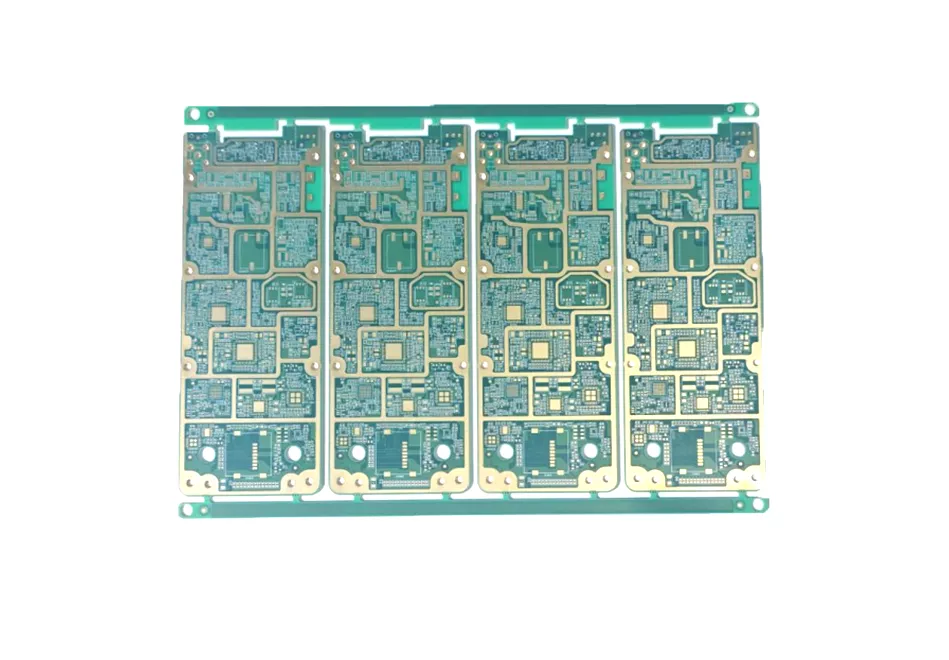
What N counts
In 1+N+1, the N is the number of core layers — the conventional, mechanically drilled layers in the middle of the board. The numbers on each side are the build-up layers added by sequential lamination.
So:
- 1+N+1: one build-up layer on each side of the core.
- 2+N+2: two build-up layers on each side.
- 3+N+3: three build-up layers on each side.
A 1+N+1 board with a 4-layer core is written 1+4+1 and has 6 layers total. A 2+4+2 has 8 layers total. The total layer count is not the order count.
The common builds
| Build | Build-up layers per side | Total build-up layers | Typical via | Cost index |
|---|---|---|---|---|
| 1+N+1 | 1 | 2 | Laser microvia, one per side | 1.0 |
| 2+N+2 | 2 | 4 | Stacked or staggered microvia | 1.6–2.0 |
| 3+N+3 | 3 | 6 | Stacked microvia, multiple passes | 2.5–3.5 |
The cost index is relative and depends on layer count, materials and via fill. It is there to show the direction, not to price a specific board.
Why each order adds cost
Every build-up layer pair adds a full sequence:
- Laminate the build-up dielectric.
- Laser drill the microvias.
- Desmear and plate.
- Image and etch the layer.
- Laminate the next layer, and repeat.
Each cycle adds registration error, handling, inspection and yield loss. A 3+N+3 board is not "a 1+N+1 with two more layers" — it is two more lamination cycles, each with its own yield hit.
The laser drilling step is the other driver. Stacked microvias require drilling through previously plated layers, which is slower and more sensitive to registration than staggered vias.
Stacked versus staggered
A stacked microvia sits directly on the via below it. It saves space and improves routing density, but it requires more lamination cycles and tighter registration.
A staggered microvia is offset layer to layer. It is easier to build and often cheaper, but it uses more area and can limit routing.
The choice belongs in the stackup, not in the fabricator's shop floor. If the design does not require stacked vias, saying so can remove a lamination cycle and a cost step.
Common counting mistakes
- Counting total layers as the order: an 8-layer 2+4+2 board is second-order, not eighth-order.
- Counting total build-up layers: 2+N+2 has four build-up layers in total, but it is second-order, not fourth.
- Mixing "阶" and "次压": in Chinese quotations, 二阶 usually means two build-up layers per side, while 两次压合 means two lamination cycles. They are not the same number.
- Assuming symmetry: an asymmetric build such as 1+N+2 is possible but harder to keep flat and usually costs more than the notation suggests.
- Forgetting via fill: stacked microvias in via-in-pad need resin fill and planarization, which adds steps beyond the order count.
What to put on the stackup drawing
- The notation, written as 1+N+1 or 2+N+2, with N replaced by the core layer count.
- A layer-by-layer diagram with dielectric thickness and copper weight.
- Via type per layer: through, blind, buried, microvia, stacked or staggered.
- The lamination sequence, or a note asking the fabricator to propose one.
- Via fill and cap requirement for via-in-pad.
- Impedance targets and test coupon locations.
- The acceptance standard, such as IPC-6012 Class 2 or 3.
If the drawing only says "8-layer HDI, second order", the fabricator will choose the build. That choice may be more expensive than the design needs.
FAQ
Is 2+N+2 the same as 4-layer HDI?
No. 2+N+2 means two build-up layers on each side of the core. The total layer count depends on N. "4-layer HDI" is ambiguous and should not be used in a quotation.
Does a higher order always cost more?
Usually, because it adds lamination cycles and laser drilling. But a well-chosen staggered build can be cheaper than a stacked build of the same order.
Can I mix orders on one board?
Yes, but asymmetric builds are harder to keep flat and need a warpage review. State it explicitly on the drawing.
How do I know which order my design needs?
Count the build-up layers required to escape the fine-pitch components, then check the via type. If a through via can reach the layer, a build-up may not be needed at all.
What to send for a stackup review
- Layer diagram with the build notation
- Via types and locations
- Fine-pitch component and escape requirements
- Impedance targets
- Via-in-pad and fill requirements
- Acceptance class
Send your HDI stackup for review, or review our HDI capability and HDI manufacturing page.
Reviewed by the Benchuang process engineering team.